
Service charges are one of the most misunderstood line items in Dubai property ownership. Every freehold and leasehold owner in a managed building or community pays them, yet few buyers ask the right questions before signing. They show up as a recurring AED-per-square-foot bill that funds everything from the lobby air conditioning to the swimming pool you may never use.
Because Dubai's service charge system is regulated by RERA and channelled through the Mollak escrow platform, owners actually have more protection than many realise. The catch is knowing how the system works, what is reasonable, and which channels to use when a bill looks inflated. This guide breaks down what service charges cover, how rates are set, and how to dispute them properly.
What service charges actually cover
Service charges fund the operation, maintenance, and long-term upkeep of the shared parts of a building or master community. They are paid by every unit owner to the Owners Association (OA), which is managed by a professional Owners Association Management (OAM) company licensed by RERA.
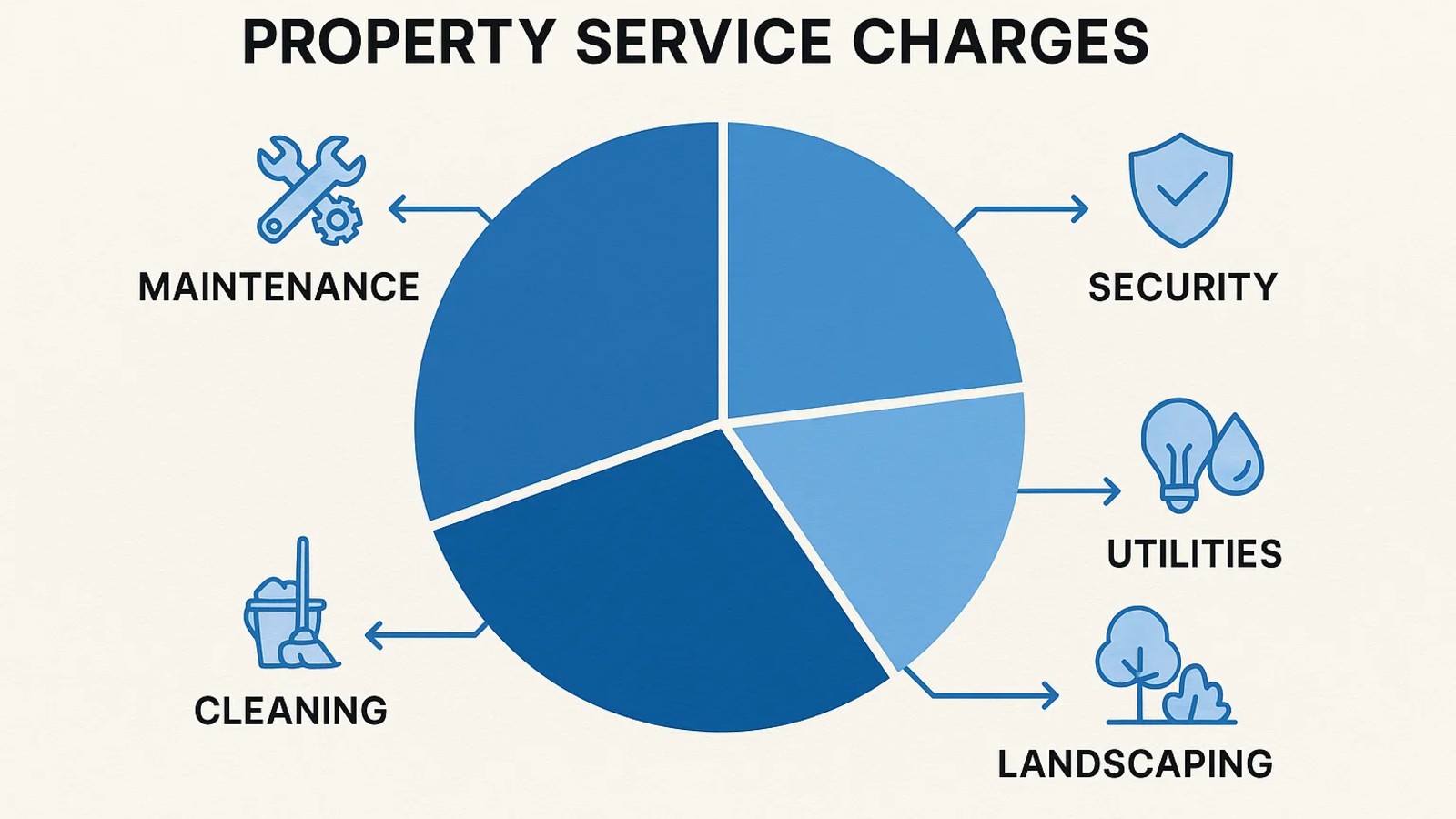
Typical inclusions break down into operating costs, reserve fund contributions, and master community fees. Operating costs cover day-to-day running. Reserve funds build up cash for major repairs like chiller replacement or facade restoration. Master community fees go to the developer or master community operator (think Emaar, Nakheel, Dubai Properties) for shared infrastructure across the wider neighbourhood.
- Building insurance and third-party liability cover
- Cleaning, security, and concierge staffing
- Lift maintenance and chiller/AC servicing
- Pool, gym, and amenity upkeep
- Common-area electricity and water (DEWA on shared meters)
- Landscaping and pest control
- OA management fees and audit costs
- Sinking/reserve fund for capital works
- Master community charges (roads, parks, district cooling infrastructure)
Chiller charges are usually separate
District cooling (Empower, Emicool, Tabreed) is typically billed directly to the occupier, not through service charges. Always confirm whether your unit is on district cooling and what the connection and consumption charges look like before buying.
Typical rates across Dubai
Service charges are quoted in AED per square foot per year, calculated on the property's BUA (built-up area) or NSA (net sellable area) as stated on the title deed. Rates vary enormously based on building age, amenity load, and management quality.
| Property type | Typical range (AED/sq ft/year) |
|---|---|
| Apartments in JVC, Dubailand | 10 – 15 |
| Mid-tier apartments (Business Bay, JLT) | 15 – 22 |
| Downtown Dubai apartments | 20 – 28 |
| Palm Jumeirah apartments | 22 – 35 |
| Townhouses (Arabian Ranches, Damac Hills) | 3 – 6 |
| Villas in established communities | 2 – 5 |
| Ultra-luxury (Bulgari, One Za'abeel) | 40 – 80+ |
As a rough rule, a 1,000 sq ft apartment in Downtown at AED 22/sq ft means an annual service charge of AED 22,000, billed quarterly. Buyers should always ask for the latest approved service charge index, not the developer's marketing brochure number, which is often understated for the first year or two.
How rates are set and approved
Service charges are not arbitrary. The OAM company prepares an annual budget, which the Owners Association reviews and submits to RERA for approval. Once RERA approves the budget, the rate is published on the Service Charge and Maintenance Index, which is publicly searchable via the Dubai REST app and the DLD website.
All collected funds must flow through Mollak, the mandatory escrow platform launched in 2018. Owners pay invoices issued through Mollak, money sits in a ring-fenced account, and the OAM can only draw against approved budget lines. This system was specifically designed to stop the historical problem of developers and managers misusing service charge money.
Check the index before you buy
Before committing to a unit, search the building on the DLD Service Charge Index. If the developer is quoting a number significantly below the published rate, ask why. New buildings sometimes have artificially low first-year charges that jump 30-50% in year two.
How disputes work
Disputes typically fall into three categories: the rate is too high, the services delivered do not match the budget, or the owner believes they have been overcharged on a specific invoice. Each has a slightly different route.
The first step is always to engage with the OAM directly in writing. Request the audited financial statements, the approved budget, and a breakdown of how your unit's charge was calculated. OAMs are obliged to share these documents with any registered owner. Many disputes resolve at this stage simply because the owner now understands what they are paying for.
If that fails, the escalation path runs through RERA's Real Estate Regulatory Agency complaints channel and, for unresolved disputes, the Rental Disputes Centre (RDC) or the Dubai Courts. Owners can file a complaint via the Dubai REST app or in person at the DLD Trakheesi Centre.
- Request budget, audit, and invoice breakdown from the OAM in writing
- Raise the issue at the Annual General Meeting (AGM) of the Owners Association
- File a formal complaint with RERA via Dubai REST
- Escalate to the Rental Disputes Centre if unresolved
- Final recourse: Dubai Courts for substantive financial disputes
Do not simply stop paying
Withholding service charges is a fast way to make your dispute weaker. Unpaid charges accrue interest, can block your ability to sell (no NOC will be issued), and the OA can ultimately seek a court order to auction the unit. Pay under protest and dispute through the proper channels.
What to check before buying
Service charges should be a core part of due diligence, not an afterthought. A unit with strong rental yield on paper can become a poor investment if the building's charges are 30% above market or trending upward sharply.
- Last three years of approved service charge rates (look for the trend)
- Reserve fund balance and any planned capital works
- Outstanding service charge arrears at building level (high arrears = future hikes)
- Whether there are any pending RERA complaints against the OAM
- Master community charges in addition to building charges
- Whether chiller/district cooling is separate or included
A simple question to ask the seller's agent: "Can I see the last two Mollak invoices?" These show exactly what the current owner pays, including any arrears or adjustments. If the agent cannot produce them, treat it as a flag.
Frequently asked questions
Are service charges negotiable?
Not at the individual owner level. The rate is set by the approved annual budget and applies uniformly per square foot across all units of the same type. Owners can collectively influence future budgets by attending the AGM and voting on cost lines.
How often are service charges billed?
Most OAs invoice quarterly through Mollak, though some bill semi-annually or annually. The full year's charge is fixed at the start of the financial year based on the RERA-approved budget.
Do tenants pay service charges?
No. Service charges are an owner obligation under Dubai law. Landlords cannot pass them on to tenants unless specifically agreed in the tenancy contract, and even then it is unusual. Tenants typically pay their own DEWA and chiller bills.
What happens if I do not pay?
Unpaid service charges accrue and prevent the issuance of a No Objection Certificate (NOC), which means you cannot sell or transfer the property. The OA can also obtain a court judgment and ultimately force the sale of the unit to recover arrears.
Can service charges increase year on year?
Yes, but only with RERA approval of the new budget. Increases are common as buildings age and reserve fund top-ups become necessary. Sharp jumps should be questioned at the AGM and supported by clear cost justifications.
Are villas in gated communities subject to service charges?
Yes, but typically at much lower rates (AED 2-6/sq ft) because there are fewer shared amenities and no building infrastructure. Villa owners mainly pay for community landscaping, security, and master community fees.